Mastering the 4 German Cases: The Definitive Guide for English Speakers
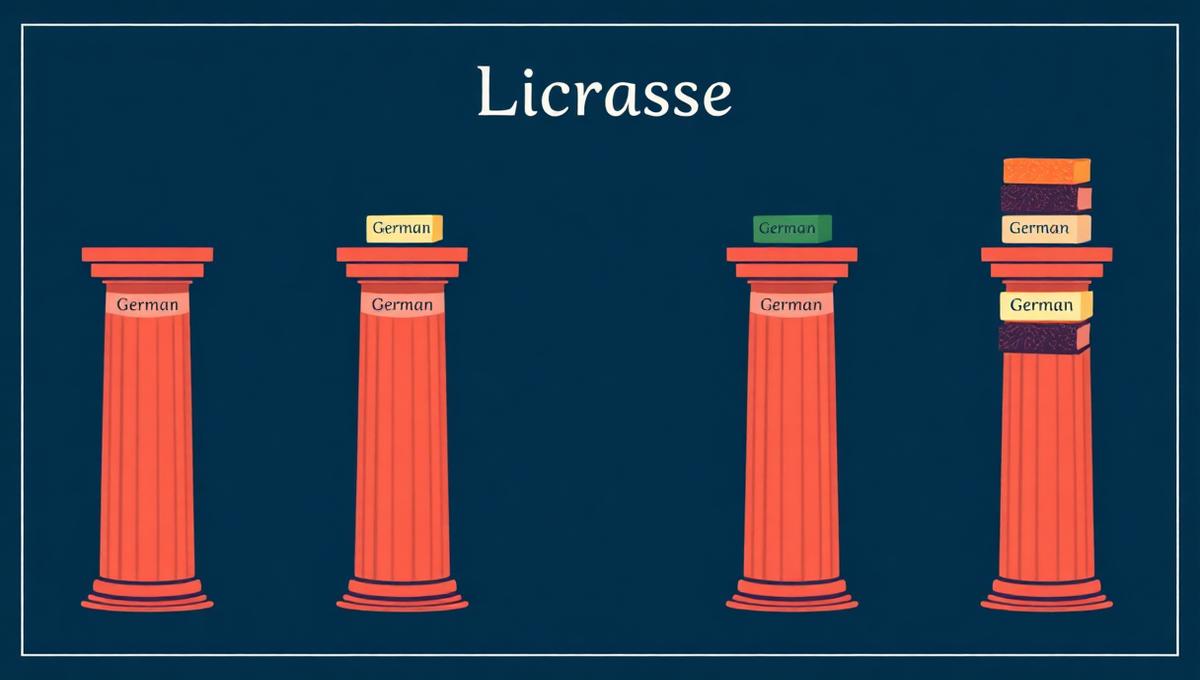
Demystify Nominative, Accusative, Dative, and Genitive cases. Learn how German cases work, why they exist, and how to master definite and indefinite articles without tears.
Master German grammar rules, cases, and sentence structure

Demystify Nominative, Accusative, Dative, and Genitive cases. Learn how German cases work, why they exist, and how to master definite and indefinite articles without tears.

Demystify German separable and inseparable verbs. Learn how prefixes detach in main clauses, reunite in perfect tenses, and interact with modal verbs and subordinate clauses.

Master German sentence structure and syntax. Understand the Verb-Second (V2) rule in main clauses, the TeKaMoLo rule for multiple adverbials, and verb-final word order in subordinate clauses.
CEFR A1.1 Pre-Read · Part 1/5Your Lesson 1–2 pre-read guide for German A1.1. Learn how German personal pronouns work, when to use 'du' vs. 'Sie', how to conjugate 'sein' (to be) and 'haben' (to have), and how to build any regular present-tense sentence.
CEFR A1.1 Pre-Read · Part 2/5Why does German have three words for 'the' (der, die, das)? In Part 2 of our A1.1 Pre-Read Series, discover reliable gender-ending shortcuts, how 'ein' and 'eine' work, compound nouns, and the 5 plural patterns.
CEFR A1.1 Pre-Read · Part 3/5Ready to build full sentences and ask questions in German? Part 3 of our A1.1 Pre-Read Series explains the unbreakable Verb-Second (V2) law, why 'Heute ich arbeite' is wrong, W-questions (wo, woher, wohin), and Yes/No questions.
CEFR A1.1 Pre-Read · Part 4/5Why does 'der Kaffee' change to 'Ich trinke den Kaffee'? Part 4 of our A1.1 Pre-Read Series makes the Accusative case effortless, breaks down when to use 'kein' vs. 'nicht', and introduces possessive articles (mein, dein, Ihr).
CEFR A1.1 Pre-Read · Part 5/5Finish your A1.1 grammar foundation strong! In Part 5 of our A1.1 Pre-Read Series, master vowel-changing verbs (du fährst, er spricht, sie liest), modal verbs with the sentence bracket (möchten, können, müssen), and time expressions (am, um, im).