Master German with AIStop Memorizing Words.Start Using Them.
Language Lift connects structured lessons, a personal Vocabulary Bank, and adaptive AI practice. Every word you learn feeds directly into speaking and writing exercises so you remember them forever. Grounded in second language acquisition research, our method transitions you from passive recognition to active production. Start your journey today and experience the difference of a vocabulary-first approach built for real-world fluency.
Start learning today. No credit card required.
Why Traditional Apps Fail to Make You Fluent
The Gamification Trap
Most popular apps are designed to maximize engagement and screen-time, not actual learning outcomes. You maintain a 500-day streak by tapping multiple-choice buttons and dragging pre-formed word blocks, but you still cannot order a simple coffee, ask for directions, or write a cohesive email in real-life situations.
No Connection Between Lessons & Practice
You learn vocabulary in one lesson, but the app never forces you to use those exact words in a subsequent conversation or writing exercise. This lack of integration means words stay in your passive memory, quickly decaying over time because they are never consolidated through active contextual production.
Passive Recognition vs. Active Production
Selecting words from a visual bank is cognitively easy. Pulling them out of your head to speak or write a sentence under pressure is a completely different skill. Traditional apps train you to be a good test-taker, whereas Language Lift trains you to be an active, confident speaker.
The Language Lift Loop
We bridge the gap between acquisition and production. Every word you learn enters your personal, dynamic Vocabulary Bank, which then automatically generates your writing exercises, AI conversations, and reviews. This closed-loop system ensures you are always practicing what you just learned, reinforcing it until it becomes second nature.
The Language Lift Loop
Traditional apps teach vocabulary in isolation. Language Lift connects acquisition, storage, active use, and corrective feedback in an unbreakable loop.
1. Read & Listen
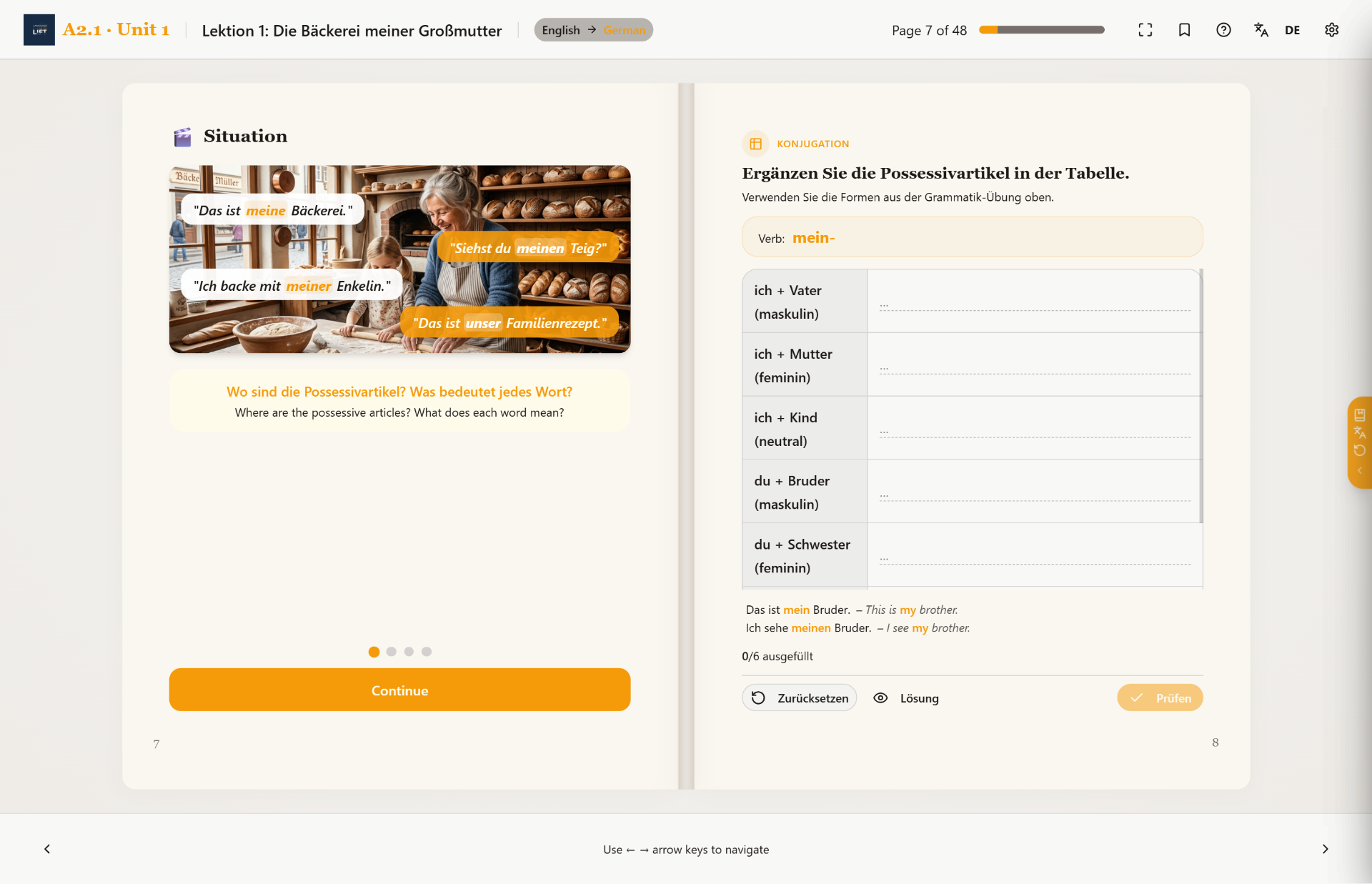
Encounter vocabulary inside natural, structured curriculum dialogues and stories.
2. Save to Bank
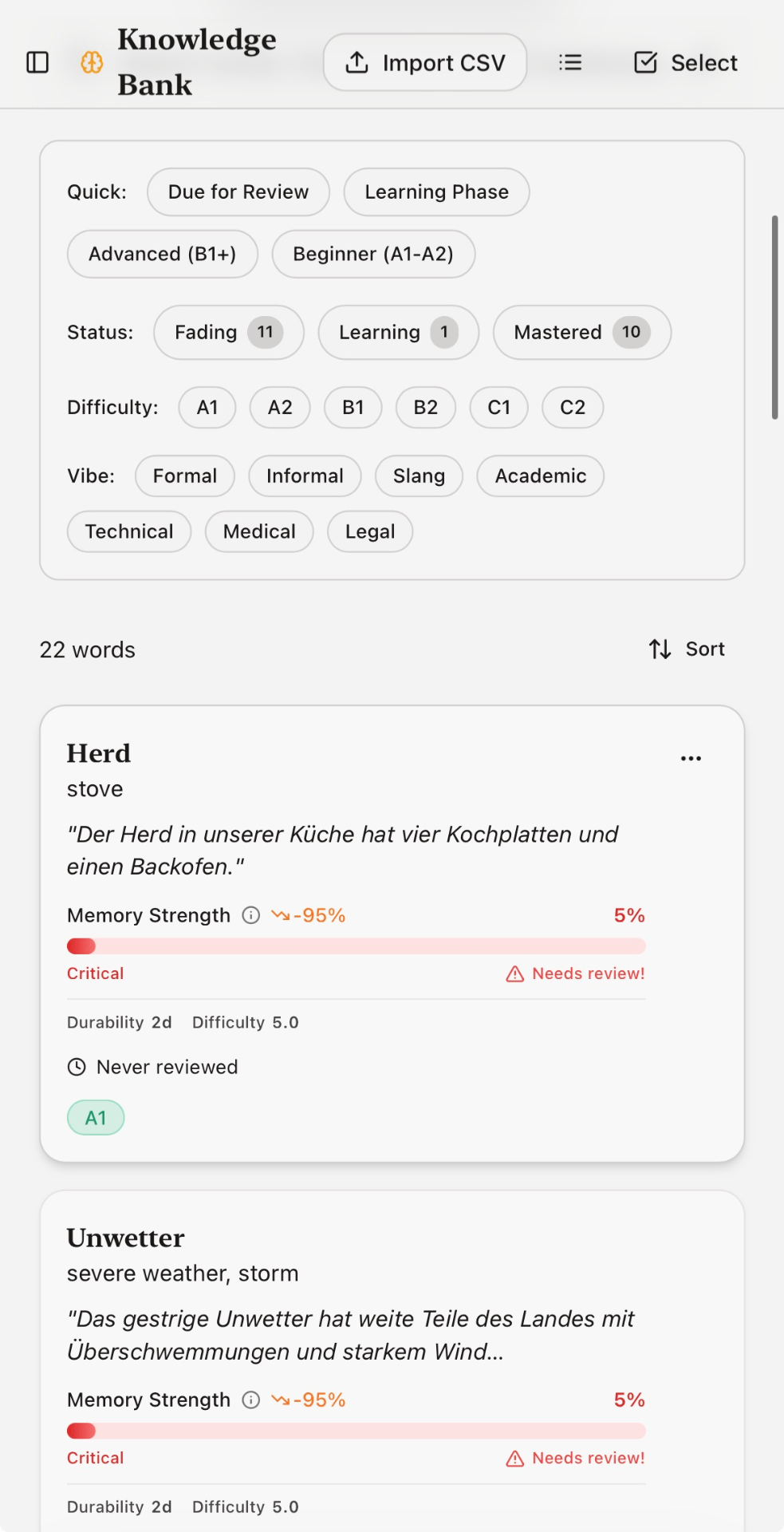
Single-tap to add unfamiliar vocabulary to your personal Vocabulary Bank.
3. Spaced Repetition
Our scheduler tests you at the optimal millisecond to prevent memory fading.
4. Write & Speak
Synthesize sentences in lessons using the exact vocabulary from your bank.
5. AI Feedback
Receive sentence-by-sentence syntax improvements and style adjustments.
6. Retain Forever
Corrected words feed back into your reviews until they become active memory.
The Science of Active Fluency
How cognitive science and second language acquisition research power our vocabulary-first learning loop.
The Science of Vocabulary Acquisition: Active Recall vs. Recognition
Many language learning apps boast millions of users, but their actual rate of conversational success remains remarkably low. The reason lies in how human memory functions. When you complete multiple-choice exercises or drag words into pre-formed slots, you are training your brain in recognition memory. You can identify the word when it is presented to you, but you cannot independently retrieve it from your neural network when you need to use it in conversation. This is the difference between passive and active vocabulary.
Active recall is the process of retrieving information from memory without any external cues. Language Lift is built entirely around this principle. Instead of choosing translations from a list, we prompt you to write full sentences and speak complete thoughts. This effortful retrieval process stimulates synaptic plasticity, strengthening the neural connections associated with that word. Over time, active recall makes vocabulary retrieval automatic, allowing you to speak fluently without halting to search for words.
Furthermore, when you retrieve a word incorrectly, the immediate feedback provided by our AI Writing Coach and Speaking Tutor triggers what cognitive scientists call the 'hypercorrection effect'. When your brain makes a prediction and receives immediate, detailed corrective feedback, it is forced to reorganize the information, leading to exceptionally strong memory retention. By combining active recall with automated feedback, we dramatically compress the time required to achieve active fluency.
Krashen's Input Hypothesis & The Vocabulary Bank Loop
In the 1980s, linguist Stephen Krashen proposed the Comprehensible Input Hypothesis, which states that language acquisition occurs when learners are exposed to messages that are just slightly beyond their current level of competence. He formulated this as 'i + 1', where 'i' represents the learner's current competence and '1' is the next step. If input is too simple, no acquisition occurs; if it is too complex, the learner becomes frustrated and disengaged.
Language Lift implements Krashen's theory through our signature Vocabulary Bank. The platform tracks exactly what vocabulary and grammar structures you have acquired in your curriculum. When our AI generates writing prompts or guides speaking exercises, it references your Vocabulary Bank. The AI is instructed to speak to you using your exact vocabulary list, while introducing 10-15% new words (the +1) in context. This ensures that every dialogue feels accessible yet intellectually challenging.
This loop prevents the common issue of vocabulary decay. In traditional classroom settings or rigid textbooks, a word is learned in Chapter 1 but never seen again in Chapter 10. With the Vocabulary Bank Loop, words you learn in earlier chapters are continuously pulled into later lessons, AI essays, and speaking exercises. This constant recycling of vocabulary across different contexts is what cements words into long-term memory.
Syntactic Processing: Why Writing is the Bridge to Fluent Speech
It is a common belief that the best way to learn to speak a language is simply to start speaking it. However, speaking happens in milliseconds. Under the pressure of a real-time conversation, your brain does not have the processing time to consciously apply grammar rules, choose correct cases, or construct complex sentence structures. As a result, learners who jump straight into speaking often develop fossilized errors—bad grammar habits that become extremely difficult to break later on.
Writing is the crucial bridge to fluent speech. When you write, you engage in deliberate syntactic processing. You have the time to think about word order (such as German verb placement in subordinate clauses), select the correct case endings, and choose precise adjectives. Writing acts as a low-pressure rehearsal for speaking. By writing full paragraphs and receiving sentence-by-sentence feedback from our AI Writing Coach, you train your brain to construct correct sentences consciously.
As you continue to write, these correct grammatical structures are transferred from your slow, conscious memory to your fast, procedural memory. When you are eventually called upon to speak, your brain does not need to analyze grammar rules on the fly; it simply retrieves the pre-built sentence structures that you have practiced writing. Writing builds the structural scaffold, and speaking breathes life into it.
Everything You Need to Reach Fluency
A comprehensive toolkit designed by linguists and language teachers.
German (A1-B2) Curriculum Milestones
Our launch edition features a comprehensive German curriculum designed by expert academic educators. Unlike other apps that provide a random selection of lessons, Language Lift guides you through a sequenced CEFR-aligned progression.
Building the Foundations
Target: 1,200 words
Learn to introduce yourself, ask and answer basic personal questions, and describe your surroundings. Master fundamental grammar including present tense conjugation, nominative and accusative cases, basic word order, and daily conversational vocabulary.
Expanding Everyday Contexts
Target: 2,500 words
Communicate about routine tasks, share stories in the simple past (Präteritum) and present perfect (Perfekt) tenses. Gain comfort with German two-way prepositions, modal verbs, and basic subordinate clauses (weil, dass, wenn).
Entering Independence
Target: 4,500 words
Express your opinions, describe dreams, and justify plans. Learn to navigate travel situations and professional settings. Grammar focuses on passive voice, relative clauses, subjunctive II (Konjunktiv II) for polite requests, and sentence-connecting particles.
Achieving Conversational Fluency
Target: 8,000 words
Understand the main ideas of complex text on concrete and abstract topics. Participate in spontaneous discussions with native speakers. Master advanced syntax, nominal style, adverbial connectors, and nuanced vocabulary for technical fields.
How Language Lift Compares
Many language learning tools claim to make you fluent. Let's look at the facts and compare how they help you transition from passive vocabulary recognition to active production.
| Feature / Method | Language Lift | Duolingo | Babbel | Pimsleur |
|---|---|---|---|---|
| Primary Learning Goal | Active Sentence Production | Passive Word Recognition | Structured Drills / Dialogues | Oral Comprehension / Pronunciation |
| Paragraph Writing & AI Coaching | Yes, sentence-by-sentence feedback | No, multiple choice & translation hints | No, basic fill-in-the-blank drills | No, oral focus only |
| AI Conversation Tutor | Yes, level-tailored speech-to-speech | No, limited chatbot (Duolingo Max only) | No, simple guided dialogues | No, pre-recorded audio prompts |
| Spaced Repetition (SRS) | Visual, customizable Vocabulary Bank | Basic review drills (hidden algorithms) | Standard review manager | Grounded in audio intervals |
| Exercise Diversity | 160+ active & multimodal formats | 3-5 matching & gamified formats | 10-15 standard text formats | 1 format (audio response loop) |
| Monthly Pricing (USD) | Free / $8 AI Labs / $15 Complete | $12.99 / mo (Super) | $13.95 / mo | $20.95 / mo |
Starting with German. Growing Fast.
We're launching with a complete German curriculum. More languages are in active development.
What Learners Say
"I tried Duolingo for a year but couldn't write a single correct email. With Language Lift, I practice writing full paragraphs and get immediate AI feedback. It's night and day."
"The way the Vocabulary Bank feeds directly into my AI speaking conversations makes it stick. It's the best implementation of spaced repetition I've seen."
"The AI speaking tutor is incredible. It knows exactly what vocabulary I've learned in the lessons and guides the conversation to use them. I don't feel judged when I make mistakes."